.png)


Chakra Healing for Beginners: A Simple Guide to Coming Home to Yourself

There's a moment — and maybe you've felt it too — when you look in the mirror and something behind your eyes feels... dim. Not sad, exactly. Not broken. Just somewhere far from yourself. Like the lights are on but the warmth has gone out of the room.
I've been there. And what brought me back, quietly and without fanfare, was learning to listen to my body in an entirely different way. Not through willpower or productivity hacks. Through energy. Through the chakras.
If you've been feeling scattered, emotionally heavy, or like something is "off" but you can't quite name it — I want you to know that this guide was written with you in mind. We're not going to go deep into ancient Sanskrit texts today. Instead, we're going to walk together, gently, through what chakra healing actually feels like — and how you can begin it, right where you are, at home.
What Are Chakras, Really?
The word chakra comes from Sanskrit and means "wheel" — and that's genuinely the best way to picture them. Spinning wheels of energy, located at key points along your body, each one connected to different aspects of your physical, emotional, and spiritual wellbeing.
There are seven main chakras, running from the base of your spine to the crown of your head. In an ideal world, they spin freely, energy moves through them with ease, and you feel — for lack of a better word — alive. Grounded and open at the same time. Present and expansive.
But life happens. Stress accumulates. Old wounds don't fully heal. We hold grief in our chest, anxiety in our stomach, unspoken words in our throat. And over time, those wheels slow down, or spin erratically, or close up like a fist around something they're afraid to release.
Chakra healing is simply the practice of bringing awareness — and then intention — back to those energy centers. It doesn't require special powers or years of training. It requires presence, and a willingness to feel.
The Seven Chakras and What They Govern
Root Chakra — Muladhara
Location: Base of the spine Governs: Safety, security, belonging, physical grounding
This is your foundation. When it's balanced, you feel stable and safe in your body and in the world. When it's blocked, anxiety, financial fear, and a constant sense of unease can take over. Many of us living fast-paced modern lives carry a chronically underactive root chakra — and we wonder why we feel unmoored.

Sacral Chakra — Svadhisthana
Location: Just below the navel Governs: Creativity, pleasure, emotion, sensuality
This is where your aliveness lives. Joy, creativity, the ability to feel deeply — all of it flows through the sacral. When it's blocked, life can feel flat. Uninspired. You may lose your appetite for the things that once lit you up.
Solar Plexus Chakra — Manipura
Location: Upper abdomen Governs: Personal power, confidence, self-worth
That "gut feeling" of confidence — or the knot of self-doubt — lives here. A blocked solar plexus often shows up as people-pleasing, difficulty making decisions, or a persistent sense that you're not quite enough.
Heart Chakra — Anahata
Location: Centre of the chest Governs: Love, compassion, grief, connection
The bridge between the lower (earthly) and upper (spiritual) chakras. When the heart is open, you can give and receive love freely. When it's closed — often from grief or betrayal — even kindness can feel threatening.
Throat Chakra — Vishuddha
Location: Throat Governs: Expression, truth, communication
Have you ever swallowed words you needed to say? Felt a tightness in your throat when asked to speak your truth? The throat chakra holds all of that. Healing here is often about learning that your voice — your real voice — is safe.
Third Eye Chakra — Ajna
Location: Between the eyebrows Governs: Intuition, clarity, inner vision
This is your inner knowing. When balanced, you trust yourself. When blocked, you second-guess everything, struggle with brain fog, and feel disconnected from your own guidance.
Crown Chakra — Sahasrara
Location: Top of the head Governs: Spiritual connection, purpose, higher consciousness
The crown connects you to something beyond the self — to the universe, to source, to whatever you call that larger intelligence. Healing here doesn't mean floating away from life. It means feeling held by it.
Signs Your Chakras May Be Out of Balance
You don't need a special diagnosis to sense when something is energetically off. Your body already knows. Some signs to pay attention to:
You feel chronically tired even after rest. You swing between emotional numbness and overwhelm without much middle ground. You struggle to speak up — or find you can't stop talking, nervously filling silence. Creativity feels dried up. You feel disconnected from your body, or conversely, trapped in it. Relationships feel draining rather than nourishing. You know something needs to change, but you can't identify what.
None of this makes you broken. It makes you human — and it makes you a candidate for the gentlest, most profound form of self-care I know.
My Experience Working With Chakra Energy
I came to Reiki and energy work not from curiosity, but from necessity. After a significant health challenge in 2017, I found myself standing at a crossroads — conventional approaches had their place, but something deeper needed tending. I needed to come back to myself at a level that went beyond the physical.
What I discovered, slowly and sometimes surprisingly, is that the chakra system is not abstract. It is felt. The first time I placed my hands over my heart center and simply breathed with intention, something shifted — a warmth, a loosening, like a fist opening. I couldn't explain it scientifically. I didn't need to.
What I've noticed in the years since, both in my own practice and in the energy I hold space for in others, is this: we often already know which chakra needs attention. We just haven't been taught to trust that knowing. The body speaks in sensations, in patterns, in the same old ache returning to the same old place. Learning to listen — without judgment, without rushing to fix — is where the real healing begins.
How to Begin Chakra Healing at Home
The beautiful thing about chakra work is that it doesn't require a special room or an elaborate ritual. It requires intention, and a few quiet minutes.
Start With Stillness
Before anything else, create a moment of stillness. Sit comfortably, close your eyes, and take three slow, deep breaths. With each exhale, let your shoulders drop. Let your jaw unclench. Let yourself arrive.
This simple act — just arriving in your body — is already energetic work.

Body Scan Meditation
Once still, slowly bring your awareness to each chakra point, moving from the base of your spine upward. You're not looking for anything specific. You're simply noticing. Does any area feel tight? Numb? Warm? Heavy? These sensations are information, not problems to solve.
Spend thirty seconds to a minute at each center. Breathe into any area that feels closed or dense. Imagine the energy there beginning to soften, to turn — gently, at its own pace.
Color Visualisation
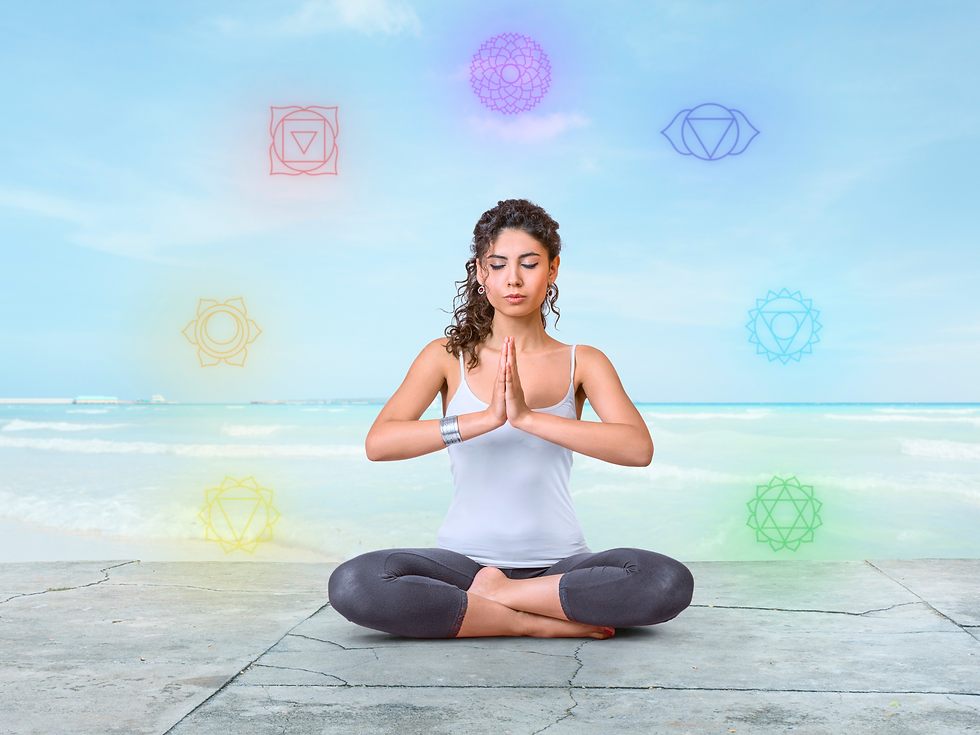
Each chakra is associated with a color, and visualization is one of the simplest healing tools available to us. As you breathe into each center, picture its corresponding color glowing softly there:
Red at the root. Orange at the sacral. Yellow at the solar plexus. Green (or pink) at the heart. Blue at the throat. Indigo at the third eye. Violet or white at the crown.
You don't need to see perfectly clear images. Even the intention of color is enough to begin shifting the energy.
Affirmations for Each Chakra
Words carry frequency. A few affirmations to work with:
I am safe. I am grounded. I belong here. (Root) I feel. I create. I am allowed to enjoy my life. (Sacral) I am enough. I trust myself. (Solar Plexus) I give and receive love freely. (Heart) My voice matters. I speak my truth with kindness. (Throat) I trust my intuition. I see clearly. (Third Eye) I am connected. I am held. I am guided. (Crown)
Speak these slowly, with your hand resting on the corresponding area. Notice what feels true, what feels aspirational, what feels tender. All of it is welcome.
Movement and the Body
Energy moves when the body moves. Even gentle yoga — particularly poses that target specific chakra areas — can begin to shift stagnation. Child's pose for the root. Hip circles for the sacral. Warrior poses for the solar plexus. Heart-opening backbends for the heart center. Neck rolls for the throat.
You don't need a full practice. Five minutes of conscious, intentional movement can do more than you might expect.
Tools That Support the Journey
While none of these are required, certain tools can beautifully support your chakra healing practice.
Crystals have been used for centuries as energetic companions. You might find that working with a red jasper or black tourmaline helps ground your root chakra, while rose quartz brings a gentle, comforting energy to heart work. Amethyst is wonderful for the third eye and crown — and honestly, it's one of the most intuitive crystals I've ever worked with.
Journaling is one of the most underrated healing practices there is. After a chakra meditation, simply write whatever arises — no editing, no grammar, no performance. A beautiful journal kept solely for this purpose becomes a record of your own unfolding. (The "Chakra Healing Journal" by Margarita Alcantara is a wonderful structured option for beginners.)
Books that I genuinely recommend for this journey: Eastern Body, Western Mind by Anodea Judith is considered the definitive chakra guide — thorough, psychological, deeply insightful. For something softer and more accessible, Wheels of Life, also by Judith, is a wonderful starting point.
Sound is perhaps the most immediate energetic tool available to us. Each chakra has a corresponding sound frequency, and simply listening to chakra-tuned music or binaural beats during your practice can amplify the work significantly. You'll find plenty of free options on YouTube or Spotify — search "chakra healing frequencies" and let yourself be guided by what resonates.
What Chakra Healing Can — and Cannot — Do
I want to be honest with you here, because I believe trust is the foundation of any meaningful healing relationship.
Chakra healing can help you develop greater body awareness and emotional intelligence. It can create space for feelings that have been suppressed to be acknowledged and moved through. It can support your nervous system in finding more ease. It can deepen your spiritual practice and your relationship with your own intuition. Many people — myself included — find it genuinely transformative over time.
What it cannot do is replace medical or psychological care. If you are dealing with a serious physical illness, a mental health condition, or acute trauma, please seek appropriate professional support. Chakra work is a beautiful complement to that care — not a substitute for it.
Energy healing works in layers, and it works slowly. There are no dramatic overnight reversals. What there is, if you stay with the practice, is a gradual, sometimes surprising return to yourself.
FAQ
1) Can anyone do chakra healing, or do I need prior experience?
Absolutely anyone can begin chakra healing — no prior experience, no special gifts required. The practices in this guide are specifically designed for beginners. Your willingness to show up with intention is all you need.
2) How long does it take to feel a difference?
This varies enormously from person to person and depends on many factors — how consistently you practice, the depth of the imbalance, and what else you're doing to support your wellbeing. Some people notice subtle shifts after just one or two sessions. For deeper, more longstanding patterns, allow yourself weeks or even months. There is no right timeline.
3) Do I need to believe in chakras for this to work?
Openness is more important than belief. You don't need to be certain. Curiosity is enough. Many people who began as sceptics found themselves quietly, undeniably experiencing something in their first chakra meditation — not because they believed, but because they were willing to pay attention.
4) Can chakra healing help with anxiety?
Many people find that regular energy practices, including chakra meditation and breathwork, significantly support anxiety management. The root and solar plexus chakras are particularly connected to anxiety patterns. That said, if anxiety is significantly impacting your daily life, please work alongside a qualified mental health professional.
5) Is chakra healing the same as Reiki?
They are related but distinct. Reiki is a specific energy healing modality in which a practitioner channels universal life force energy. Chakra healing is a broader practice of working with the body's energy centers. Reiki often incorporates chakra balancing as part of a session, but you can work with your chakras without formal Reiki training.
6) Can I combine chakra work with other spiritual practices?
Yes — and in my experience, this is where things get truly beautiful. Chakra work integrates naturally with meditation, yoga, breathwork, crystal healing, sound therapy, and intuitive practices like oracle cards. Trust your own inner guidance about what to combine and when.
A Gentle Closing
If you've read this far, something in you was already ready.
You don't need to have it all figured out. You don't need the perfect crystals or the ideal meditation space or complete certainty about what you believe. You just need to begin — quietly, gently, with one hand on your heart and a willingness to listen.
Start with the body scan tonight. Light a candle if you like. Breathe slowly. Notice what you notice. That's it. That's enough.
The chakras don't ask for perfection. They ask for presence.
If you feel called, explore the tools and books mentioned here. Come back to this guide when you need a reminder. And know that wherever you are in your journey — at the very beginning, or returning after a long break — the energy within you has never stopped moving, never stopped trying to find its way back to balance.
You are not broken. You are simply remembering.
Love and Light

Medical Disclaimer: This article is for informational and spiritual guidance purposes only. It is not intended as a substitute for professional medical or psychological advice, diagnosis, or treatment. Always seek the guidance of a qualified healthcare provider with any questions you may have regarding a medical condition.


Comments